How to Store Keycaps and Switches Properly
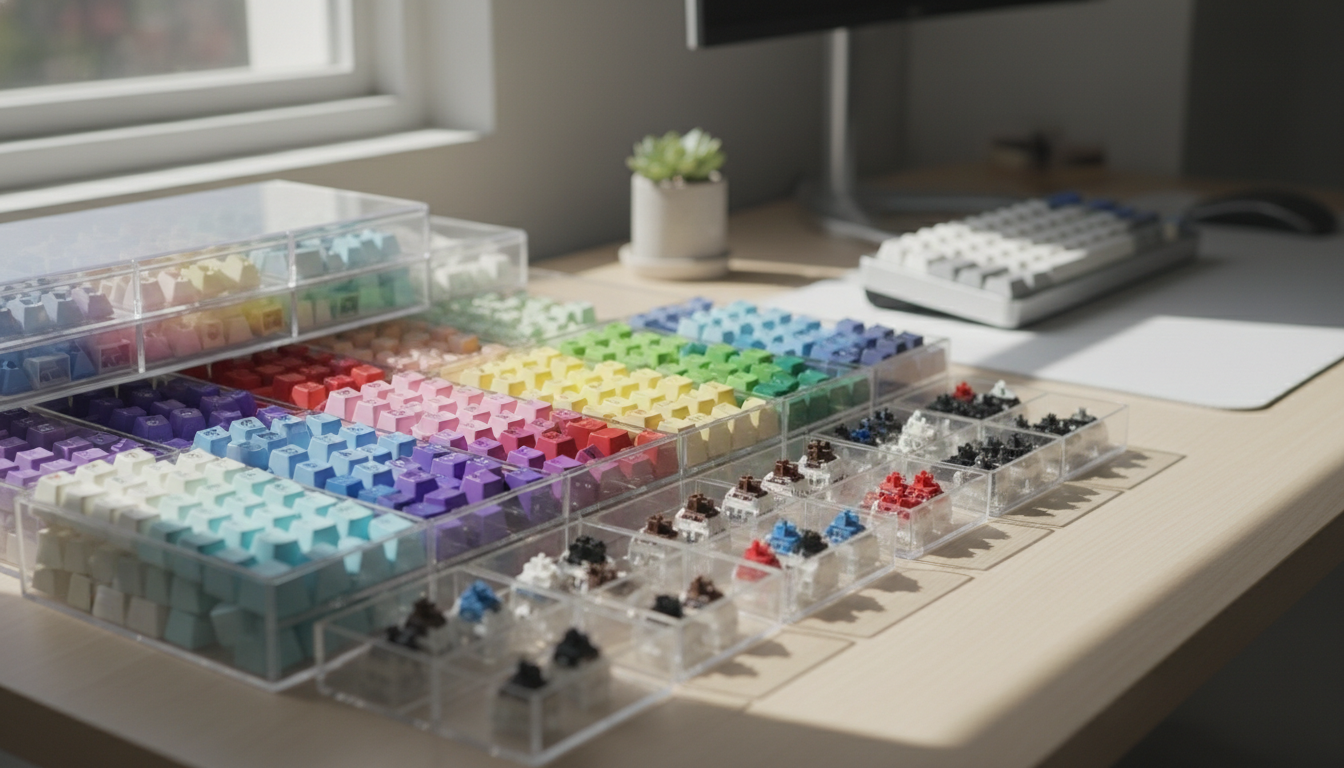
Collectors accumulate fast. A few group buys later and you’ve got loose switches rattling around in poly bags and keycap sets stacked in their original boxes with no room left on the shelf. The short answer: airtight containers for switches, padded or slotted storage for keycaps, and a system that lets you actually find things.
Here’s how to set that up without overcomplicating it.
Why Storage Actually Matters
Keycaps — especially doubleshot PBT and dye-sub sets — are more durable than they look, but they’re not immune to damage. Stacking legends face-down against other hard surfaces scratches them. UV exposure from a sunny shelf fades legends on some dye-sub caps over months. Dust settles into textured surfaces and is annoying to clean out.
Switches have a different problem. Dust and debris work their way into housings and contaminate lube jobs you spent hours on. Humidity can cause spring rust over time, especially on cheaper springs. And loose switches bouncing around a bag will develop scratches on the housing that, while cosmetic, are frustrating when you paid premium prices.
Storing Keycaps: The Core Options
Original trays are your best friend. Most group buy sets ship with a molded plastic or foam tray that holds each cap in its own slot. If you kept those, use them. They’re purpose-built, prevent contact between caps, and stack reasonably well in a drawer or on a shelf.
If you’ve tossed the tray or bought a set secondhand without one, there are two solid alternatives:
- Compartmentalized craft boxes — Plano and Raaco both make adjustable-divider boxes that work well. Look for ones with individual lid latches so they don’t pop open when stacked.
- Foam-lined cases — Pick&Pluck foam cases (the kind used for camera equipment) let you customize cavities for each cap. More work upfront, more protection long-term.
Avoid throwing loose caps into a ziplock bag for anything longer than transport. Caps will shift, legends will contact each other, and you’ll find scuffs on your favorite set.
Storing Switches: Bulk vs. Sorted
How you store switches depends on whether you’re keeping bulk stock or a sorted collection of different types.
For bulk switches — if you bought 200 Gateron Yellow KS-3s to have on hand — small rectangular airtight containers work perfectly. Sistema and Iris (the craft brand, not the keyboard) both make stackable containers with snap-lock lids. Throw in a silica gel packet and you’ve addressed the humidity issue.
For a mixed collection with multiple switch types, a parts organizer with labeled compartments is more practical than individual containers for every switch. Stanley and DeWalt make stackable organizers with adjustable dividers that hold dozens of switches per section. Label each section. This sounds obvious until you’re squinting at a Boba U4 and a U4T trying to remember which is which.
A few specifics worth knowing:
- Store switches housing-up or housing-down, not sideways — the stem can shift and the spring can warp under sustained side pressure.
- Don’t mix lubed and unlubed switches in the same compartment unless they’re bagged separately. Lube transfers.
- Tactile and linear switches can look nearly identical from the outside. Label aggressively.
Long-Term Considerations
If you’re storing keycaps for more than a few months, keep them away from direct sunlight. A drawer, a closed cabinet, or a box on a shelf all beat a display stand near a window. This matters more for dye-sub legends than doubleshot, since doubleshot color goes through the entire cap and won’t fade, but both will collect UV-related yellowing on the cap body itself over years.
For switches stored long-term, the main risk is spring corrosion. Stainless steel springs (found in most modern switches) are largely rust-resistant, but carbon steel springs — common in budget switches — aren’t. The silica gel packet solution handles this. Replace packets annually if you’re in a humid climate.
Lubed switches stored long-term can see lube migration — oil-based lubes especially will redistribute over time. Don’t expect the lube job to be identical after 12 months of storage. A quick rattle test before installing will tell you if anything sounds off.
Building a System That Scales
The mistake most collectors make is optimizing for the current collection size. Buy storage that handles roughly twice what you have now, or buy modular systems you can expand.
Modular picks worth considering:
- Raaco Assorter 55 — stackable, individual-locking compartments, European brand with good build quality
- Plano 3600 series — cheap, widely available, adjustable dividers, and they stack securely
- KAM/GMK original trays — if a seller is offloading sets, ask if trays are included; they often are
For keycap sets you actively use or swap between boards, a shallow open tray on the desk is fine. For sets you’re keeping sealed, treat them like collectibles: dark, stable temperature, minimal humidity.
Bottom line: Airtight containers with silica gel for switches, slotted trays or compartmented cases for keycaps, and consistent labeling from day one. The right system costs under $30 and saves you from scratched legends and rusted springs.